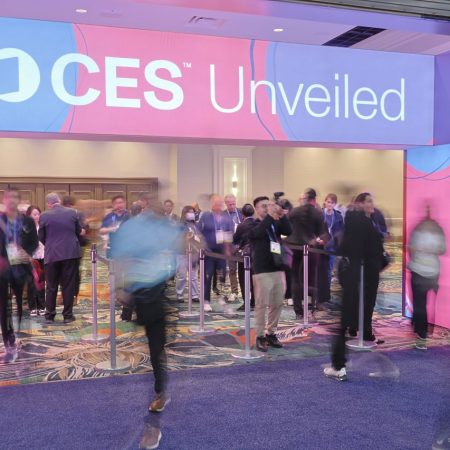



Auracast was front and centre of this year’s CES show in Las Vegas, and a special seminar – available online – helped visitors learn more about where they can expect to see Auracast appear this year … including a Disney experience.
The session was designed to help attendees better understand the transformative capabilities of Bluetooth LE Audio.
Bluetooth SIG, Listen Technologies and Williams AV teamed up for the presentation, which can be watched on the CES website – sadly, without subtitles (updated: there are subtitles available). The session was given the following billing: “Auracast broadcast audio is pioneering accessible audio for all, with public deployments and devices designed to create universal, inclusive listening experiences”.
Taking part were Henry Wong, Director of Marketing Development at the Bluetooth SIG; Wayne Whiteley, Project Manager at Listen Technologies; and Luke Westin, Senior Global Product Manager at Williams AV.
‘2025 saw Auracast infrastructure become a reality’
Henry was the first to speak, looking back at the advances of the past 12 months, the state of the market and the momentum building: “2025 is the year that Auracast infrastructure became a reality,” he said, reminding people that this is a technology for everyone, not just people with hearing loss.
“Bluetooth has been leading audio innovation for the last 20 years,” he continued, adding that members of the SIG, including hearing aid manufacturers, came together to look at the future of full wireless audio, and it was this that started the pathway to LE Audio and Auracast.
“LE Audio is a flexible audio architecture that’s designed to support the next 20 years of audio innovation,” Mr Wong said. “LE Audio brings a new enhancement to the market, providing a higher quality, lower power consumption for audio devices, and provides a new interoperable standard device for hearing aids, allowing users to have more flexibility.
“(It enables) the introduction of Auracast. We believe Auracast will enable the next generation of assistive listening systems and provide enhanced audio experience for everyone … it will help your world sound better.”
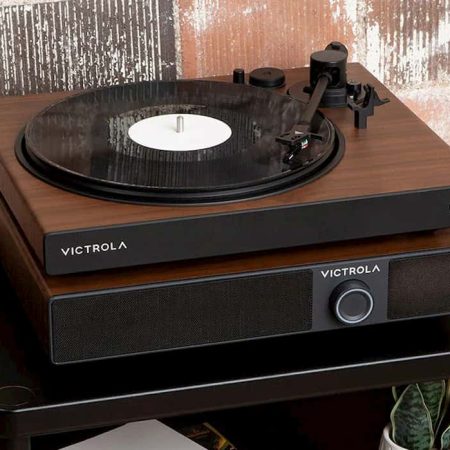
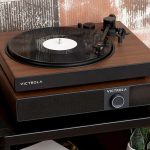
MORE AURAHEAR: CES 2026: Victrola launches Soundstage – complete with Auracast
Mr Wong then explained how Auracast works compared to Classic Bluetooth, allowing multiple users to connect to a broadcast at the same time, and also providing a direct transmission rather than going through an intermediary device. He also touched on people’s ability to choose between different Auracasts.
In a section looking at Auracast deployment, Mr Wong detailed that it was in 17 different countries: Austria, Belgium, Canada, Czechia, Denmark, Finland, France, Germany, Israel, Italy, Japan, the Netherlands, New Zealand, Norway, South Korea, the United Kingdom, and the United States.
Venues include Blackfriars Theatre in New York, the Marriott Theatre in Chicago, the Rosary Basilica in France, Sydney Opera House in Australia, the Åsane Arena in Norway, and the Karlsruhe Institute of Technology in Germany.
Auracast technology is spreading rapidly: by 2029, it is expected that 3.1 billion devices will be shipped with LE Audio technology, and 1.5 million venues will be deploying Auracast.
“By 2050, our world will have a population of 10 billion people. This is a huge opportunity to advance accessibility and connection,” he said. “Auracast is the future, enabling seamless broadcast to countless devices, profoundly connecting people through public announcements, immersive audio experience and audio sharing to be a more inclusive and connected society.”
Auracast in the Hard Rock Café
Wayne Whiteley from Listen Technology was the next to speak, representing the Auri Auracast system.
“We began shipping in January 2025. There has been a lot of excitement, a lot of interest in this type of technology,” he said. Its Auri range includes a transmitter and a receiver unit that can be borrowed by people visiting a venue.
Auracast has high-quality audio with low latency, and this transforms the listener’s experience, as Wayne explained: “In (a busy) environment, you hear all the background noise and everything else that’s going on … (with Auracast) you can really understand and hear it all. It’s not just for people with hearing loss, anybody can benefit from this type of high-quality audio in lots of different types of venues.”
Wayne highlighted several installations, starting with the Hard Rock Café in Dubai which hosts live music and constant ambient activity. This can be overwhelming for people with hearing loss, especially during busy times. By installing the Auri Auracast, guests can tune in using their own equipment and hear the performances … and also set the volume at a level comfortable to them.
“It’s transformed the user experience and allows users to hear what they want to hear. They have one transmitter covering the floor,” Wayne said.
He also highlighted work at Oxford University to create a campus-wide standardisation of assitive listening solutions. As a pilot, they started with Blackwell Hall, a Grade I-listed building which has stonework that can’t be disturbed, so the Auri system was carefully installed.
The third venue was Sydney Opera House, which has modernised its assistive listening setup to include Auracast, and Ellis Island – neighbouring island to the Statue of Liberty – is having Auracast installed. This will allow people to interact with interactive kiosks and guided tours.
Wayne also highlighted a number of US universities that are working on Auracast installations as it standardises what used to be a mix of systems, such as infrared, Telecoils and WiFi. By having one setup, users can have confidence in hearing a lecture more clearly using their own equipment, such as earbuds, regardless of which venue they are in.
And in a development that will be a world first, Wayne said Disney Cruise Line is backing Auracast.
“They’re installing Auri on their first Disney Adventure ship. Its maiden voyage is supposed to be in March 2026, and then after that expanding (Auracast) to the rest of their cruise lines. The Disney parks’ technical teams are also piloting programmes in their parks and attractions.
“It’s been really exciting to see the interest and the type of companies that want to be on the forefront and get ahead of the curve … we see the excitement every day of people having interest in these types of solutions.”
How Auracast is overcoming sound barriers
The third part of the presentation was given by Luke Westin from Williams AV, which makes the Infinium system.
He started by reminding audiences of the importance of sound in our everyday experiences, particularly in venues such as theatres, classrooms, stadiums, and airports.
“Unfortunately, for many millions of people, that experience comes with barriers,” he said. “Auracast is overcoming a lot of those barriers.”
He said that Williams AV has had a lot of success with Auracast installations in North America, Europe, the Middle East and Australia. Those listening can “tailor their experience to their unique needs”.
One installation is the Santa Fe Opera House in New Mexico: an outdoor space where, if there it is a windy evening, Auracast can still help people enjoy a full experience as the sound from the stage is transmitted directly to their ears.
Luke also talked about work Williams AV has carried out with the Johns Hopkins University: “The takeaway here is that leading universities have shifted onto Auracast and we expect others to follow.”
Elsewhere, they have helped the Latter Day Saints Church in Norway to install a system, along with other places of worship across the world.
“This technology is growing rapidly at a global scale. Why might Auracast be important for a house of worship? From an audience perspective, you have a very diverse audience, a lot of different ages, a lot of different abilities, a lot of different languages and technology … that can’t get in the way of the message in a house of worship.
“Auracast is simple: you walk in, you connect to your stream that meets your needs.
“Maybe you just want to hear the message clearly, or maybe you want to hear it in your own native language. Maybe, if you are on the blindness spectrum, you want to hear an audio description of some sort. (Auracast is) so super versatile and super simple.”
Luke also focused on sports stadiums, including installations at the Arrowhead Stadium in Missouri, the Kia Center in Florida, and the Gillette Stadium in New England.
The advantage for sports fans who attend and tune in to an Auracast is that everyone can experience the performance as intended, regardless of where they are seated; various streams can offer audio description, translation, and assistive listening solutions; and the system can be setup for past, present and future technologies.
“Stadiums are kind of where we need to transform chaos into connection,” Luke said. “There is a lot going on in a stadium. They are some of the loudest and most acoustically challenging places on the planet. You have all kinds of things like crowd noise, competing audio sources, echoes … you add alcohol to the mix, and this can be a pretty exciting place.
“People need to rely on audio play-by-play.”
He also focused on airports where Williams AV is having some “very interesting” conversations: “One of the most complicated audio spaces we design for … airports are kind of a tangle of information, noise pollution.
“Imagine being in the security line and being able to hear only your information for your gate and you’re not even at your gate. That’s pretty cool. Hearing that information in your own native languages, that is super cool … these relieve stress and improve airport navigation.”
He concluded: “The future will not just be louder, it will be clear, it will be smarter, and it will be more inclusive than ever.”
The presentation to CES 2026 can be seen here: https://www.ces.tech/videos/from-promise-to-progress-auracast-delivers-inclusive-audio-at-scale-presented-by-bluetooth-sig/