


The launch of Auracast at two gates in Frankfurt Airport is a major moment in the development of the shared audio standard. The deployment makes air travel easier for those who need a boost in hearing announcements, in whatever language they may use.
The advantages go beyond the hearing-impaired. For example, for those whose first language isn’t German or English, hearing announcements directly through their headphones, earbuds, or hearing aids will help: the message will stand out above ambient noise, making it easier to follow.
The launch event took place on Wednesday, January 28, at Gates A16 and A17 in Terminal One of the German airport.
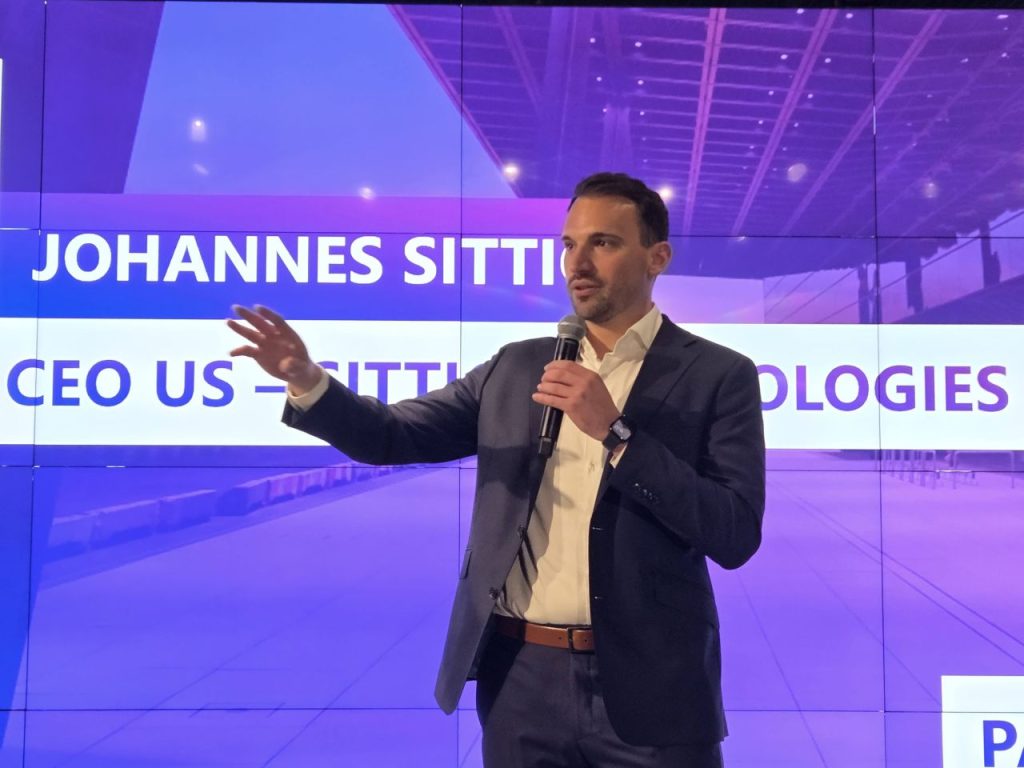
It included speeches from Alexander Laukenmann, the senior executive vice president aviation at Frankfurt Airport (Fraport); Johannes Sittig, CEO US of Sittig Technologies; and Louise Solonar-Unterasinger, CIO of the State of Hesse, Hessian Ministry for Digitalisation and Innovation.
Guests were then invited to tune into history, either by using their own Auracast-enabled hearing aids, or borrowing headphones provided by Samsung, one of the partners for the event.
The initial announcement was broadcast in French, German and English:
“This is the world’s first system for broadcasting airport announcements via Auracast Bluetooth, which offers modern and barrier-free communication directly to passengers’ personal devices.”
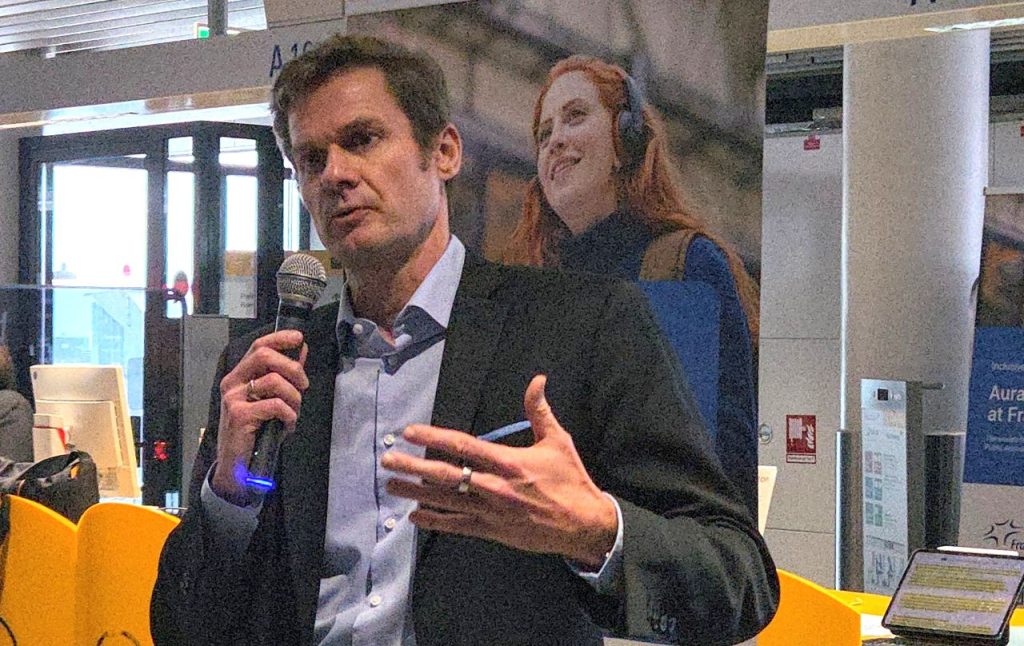
Welcoming people to the opening ceremony was Alexander Laukenmann, who said: “Let’s be honest, airports are not normally a very quiet place. It is very busy, people are very stressed out and, on top of it, you will have a lot of gate announcements. Some of them are quite important, and if you miss them, you might also miss your flight.
“We were looking for quite some time for how we could handle that situation, how we could provide a better solution for our passengers. Then, thankfully, Auracast came around.
“We were very eager to test it here in Frankfurt Airport. It’s a test now, but we see the potential for the future.”
That includes working on “any possible language for our passengers”.
MORE ON AURACAST AT FRANKFURT AIRPORT:
• ‘Auracast opens up a whole new world for accessibility’
• Frankfurt Airport has Auracast – this is why it matters
• Frankfurt Airport launches world’s first airport Auracast system
The project has been funded with support from Hesse’s Ministry of Digitalisation, and Louisa Solonar-Unterasinger represented it, sharing some of the hurdles she – and all passengers – experience when getting to an airport gate: “My journey to Terminal One involved various steps, including the security checkpoint. These barriers I was able to overcome quite easily but people who rely on a wheelchair or walking aid perceive them as barriers and obstacles. The same applies to hearing-impaired people.
“A barrage of information bombards them in large, overlapping halls. Even people without hearing aids or impairments reach their limits and don’t hear the announcements.”
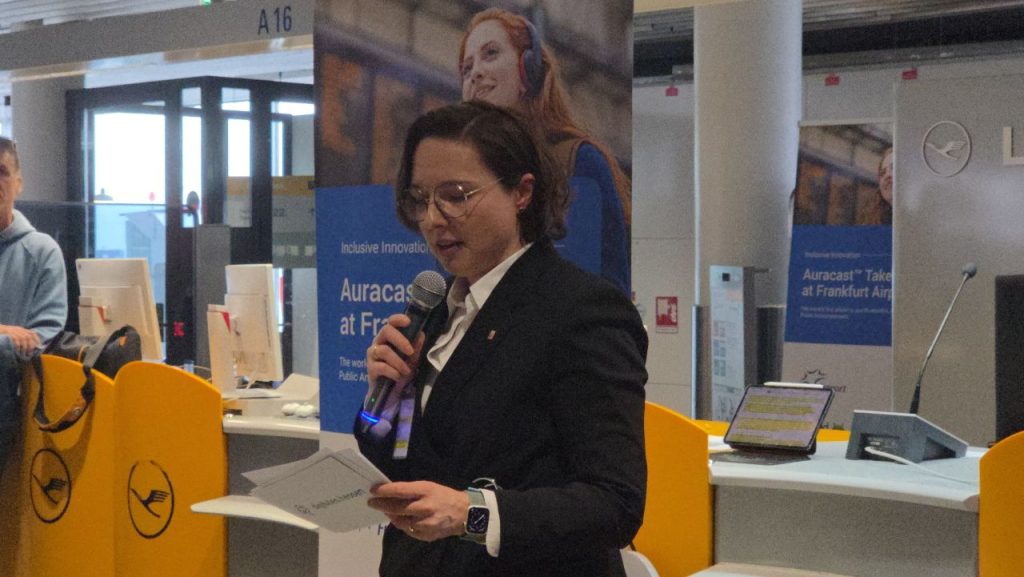
She can see the benefits that Auracast will bring to passengers.
“This is a prime example of what the digital funding programme was launched for in 2019, and what it can achieve,” she added. “This event has made it clear to me what digitalisation should be all about. Basically, for people, digitalisation should function as a service and simplify processes, make people’s everyday life easier and break down barriers.”
Later in the afternoon, there were speeches from Marcel Brühne from Fraport and Johannes Sittig.
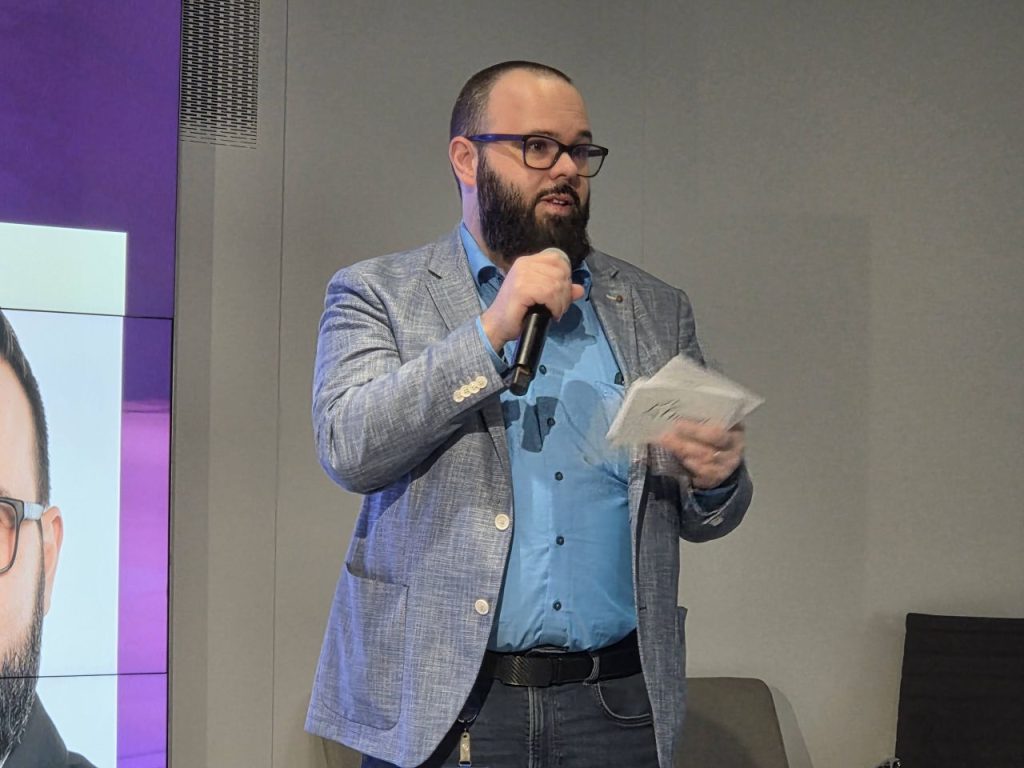
“Frankfurt Airport is a place where communication matters every minute,” Marcel said, adding that its planes fly to more than 300 destinations across the globe. “We have a highly international and multilingual passenger mix.
“Airports are noisy and acoustically complex; announcements always compete with background noises. It’s a big challenge for every passenger and every airport operator. Travellers with hearing loss are especially affected.”
It was felt that existing tools, such as hearing loops, fall short because they have limited coverage, scalability, screens and support information. This means they cannot replace spoken announcements.
“Auracast means that information arrives directly on personal devices in real time, and this creates a whole new option for airport communication.
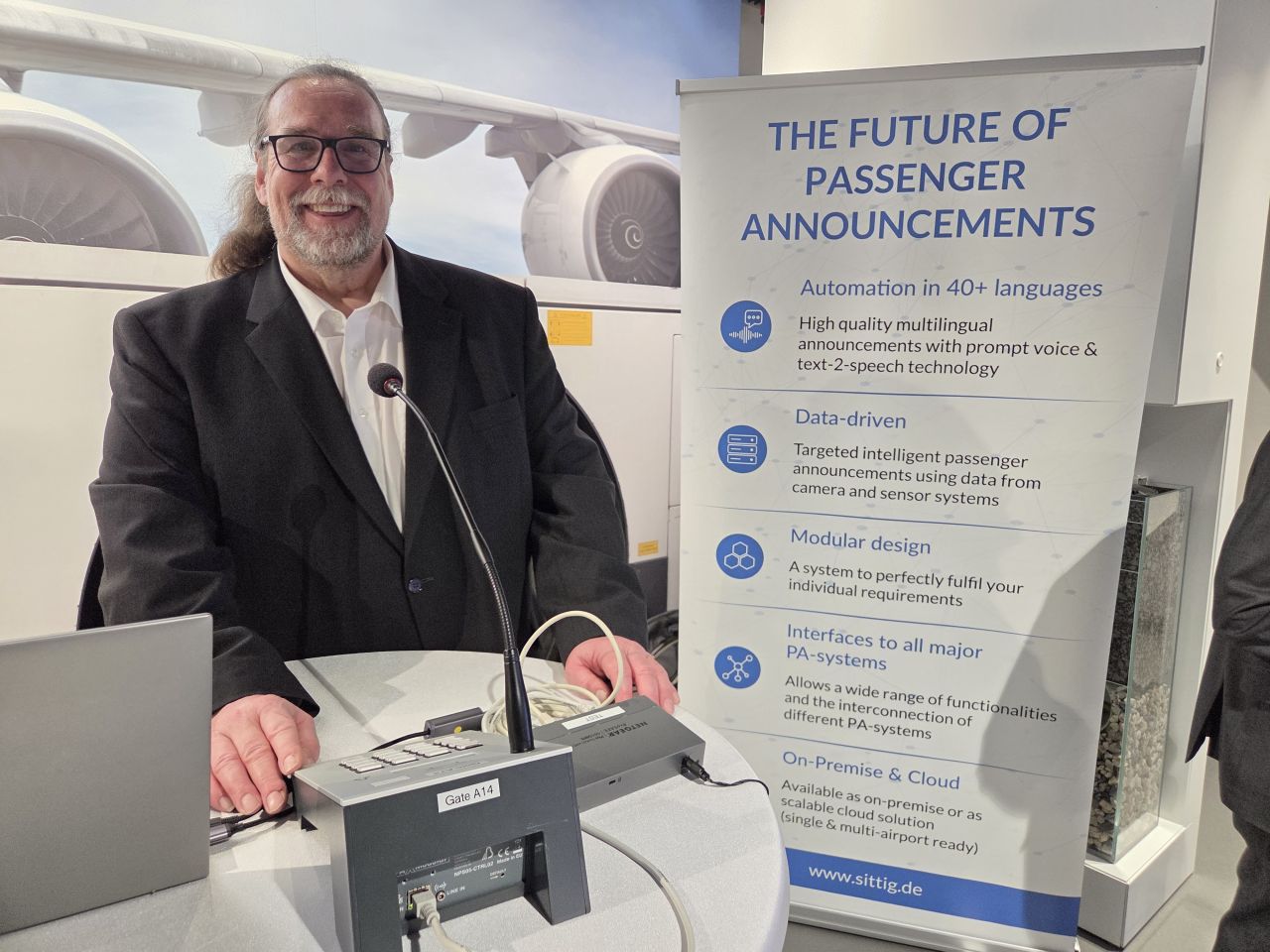
For this trial, the Sittig team modified the transmitters at both gates, adding an Auracast transmitter. Unlike other solutions, which require a separate Auracast transmitter unit mounted on the wall, these units are integrated into the microphone station.
“They’re installed at every gate at Frankfurt Airport, where usually manual announcements are made. For this pilot, we equipped those microphone stations with Auracast transmitters,” Johannes Sittig said.
This has the advantage of reducing the challenges of installing separate transmitters: finding wall and ceiling spaces, ensuring appropriate permissions are obtained, and the work and costs involved. Instead, it is a nimble solution.
“With this, we are using the existing infrastructure and adding to enable the new technology without replacing any hardware or infrastructure,” Johannes added. “This mic station works as an Auracast stream for the gate area.
“We currently have one stream per gate, but this can be multiple streams for each gate.”
A lot of work had gone into creating this trial, with the Sittig and Fraport teams collaborating with the University of Frankfurt, building on what was already known about existing Auracast installations, such as theatres.
The initial installation of the hardware took place in November 2025, with the team visiting on a regular basis to iron out kinks, including, of all things, a hot dog cart which was thought to be causing interference. It is ready for public feedback, and the pilot will run through the end of March.
“Now we want to bring in users and get their feedback, see how this really works in the field and gather feedback,” Johannes added.
We look forward to seeing the results.






Leave a comment